null Skip to main content

Fiberglass Planters: PPM QuickShip in about a week off-peak · two weeks May–July

(888) 381-9501
(888) 381-9501

Commercial Planter Sizing Guide

Commercial planter sizing is one of the easiest places to make an expensive mistake.

A planter can be technically large and still look too small in a hotel entry, courtyard, rooftop, pool deck, office lobby, restaurant patio, or storefront.

The right size is not just about matching a pot to a plant.

It is about matching the planter to the space, the plant material, the visual scale, the operating layout, delivery access, filled weight, drainage plan, and maintenance approach.

A strong commercial planter sizing plan helps answer practical questions:

  • What is the scale of the building or space?
  • What plant material will be used?
  • Is the planter defining space, framing an entrance, creating privacy, or holding a tree?
  • How wide are walkways, patios, doors, elevators, and access paths?
  • What is the filled weight of the planted system?
  • Can the planter be delivered, moved, installed, maintained, and matched across the project?

This guide will help landscape architects, architects, designers, contractors, hotel teams, restaurant operators, multifamily property managers, office property managers, commercial property owners, facilities teams, developers, retail and storefront teams, rooftop amenity planners, and high-end residential designers choose commercial planter sizes.

If you already know the general direction, start with large planters, commercial planters, outdoor planters, planter boxes, or tree planters.

Why Commercial Planter Sizing Is Different

Commercial environments are larger, more visible, and more operationally complex than residential spaces.

Planters may be used at wide entries, large patios, rooftops, courtyards, pool decks, lobbies, walkways, restaurant fronts, office interiors, and shared amenity areas.

They also need to work around furniture layouts, guest movement, tenant movement, resident movement, customer movement, staff movement, cleaning routines, maintenance access, plant material, and root volume.

Commercial planter sizing needs to account for:

  • Building scale
  • Wide entries
  • Large patios
  • Rooftops
  • Courtyards
  • Pool decks
  • Lobbies
  • Walkways
  • Furniture layouts
  • Guest, tenant, resident, customer, and staff movement
  • Cleaning and maintenance access
  • Plant material and root volume

The planter should look intentional in the space and still be practical to receive, place, plant, maintain, and replace if needed.

Size the Planter to the Space, Not Just the Plant

One of the most common commercial planter mistakes is sizing only for the plant.

The plant matters, but the space matters too.

A planter that looks large online may disappear in a large commercial space.

Before choosing a planter size, consider:

  • Building height
  • Door height
  • Facade width
  • Lobby volume
  • Courtyard scale
  • Patio depth
  • Pool deck size
  • Rooftop openness
  • Restaurant seating layout
  • Walkway width
  • Sightlines
  • Viewing distance

The farther away people view the planter, the more scale it usually needs.

A small planter may look fine beside a residential front door, but it may look weak at a hotel entry, office lobby, multifamily courtyard, restaurant patio, shopping center, or broad pool deck.

The goal is to choose a planter that fits the space visually and physically.

It should have enough presence to look intentional without blocking movement, crowding furniture, or creating access problems.

Size the Planter to the Plant Material

Planter size also needs to support the planting plan.

Different plant material has different needs for root volume, stability, soil, water, drainage, and maintenance.

Consider the planter size for:

  • Trees
  • Palms
  • Shrubs
  • Grasses
  • Seasonal planting
  • Upright screening plants
  • Small decorative plants
  • Interior foliage
  • Artificial planting where appropriate

Larger plant material usually needs more planter volume, more stability, and more maintenance planning.

Tree and palm planters need particular care because they are not just decorative containers. They need to support root volume, filled weight, drainage, stability, and long-term plant health.

For tree-scale planning, see tree planters and the tree planters buying guide.

Planter Height, Width, Length, and Depth

Planter size is not one number.

Height, width, length, and depth all affect how the planter looks and performs.

Height

Planter height affects visual presence, planting height, sightlines, and how the planter relates to people moving through the space.

Tall planters often work well for entries, door framing, vertical accents, lobby approaches, storefronts, and hospitality entrances.

Low profile planters work better when the planter needs to define space without blocking views.

Taller formats can also support partial screening, but the plant material still matters.

Height should be considered in relation to the plant material, viewer sightlines, building scale, and the need for visibility across the space.

Width and Diameter

Width and diameter matter for round planters, tree planters, cube planters, and statement planters.

They affect root volume, stability, visual weight, and how much floor or ground area the planter occupies.

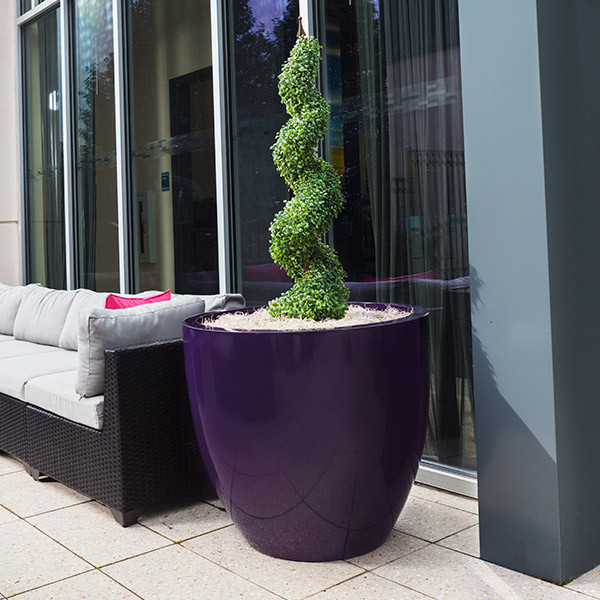
Large round planters can create strong focal points in entries, courtyards, pool decks, plazas, and hotel environments.

Cube and square planters can add architectural weight and work well in pairs, grids, or structured layouts.

Length

Length matters most for long planter boxes, divider runs, patio boundaries, privacy screens, and walkway edges.

Long planter boxes usually create cleaner commercial lines than many small pots placed side by side.

They can define seating areas, outdoor dining zones, rooftop edges, walkways, restaurant fronts, and privacy runs with fewer pieces.

Depth

Depth affects root volume, stability, and whether the planter fits the site.

This is especially important for balconies, patios, corridors, sidewalks, narrow storefronts, and rail-adjacent spaces.

A planter that is too deep can make a balcony or sidewalk feel crowded. A planter that is too shallow may limit planting options or stability.

Depth should be coordinated with furniture layout, walking space, plant material, and access.

Common Commercial Planter Size Use Cases

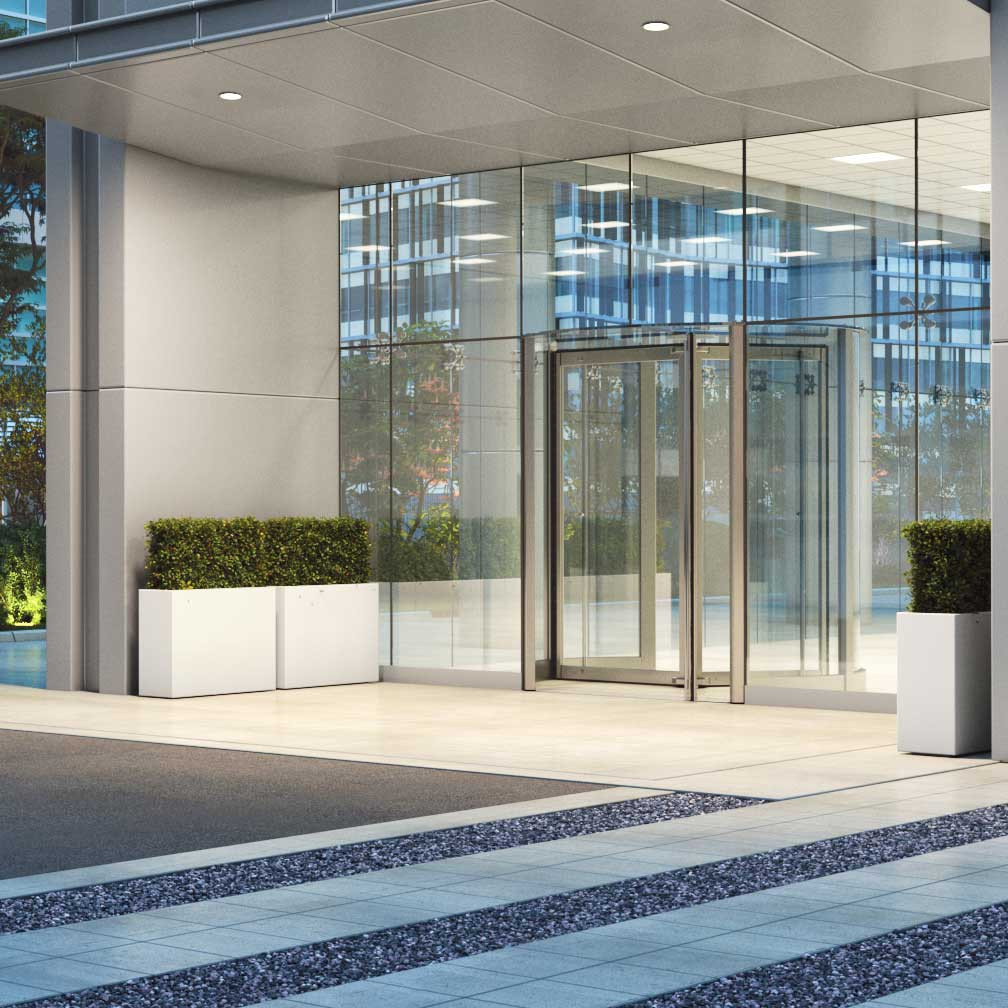
Entry Planters

Entry planters need to match the scale of the building and door.

Tall planters, square planters, cube planters, large round planters, and paired planters are common choices.

The biggest risk is undersizing. A planter that looks large online may look small beside tall doors, columns, broad paving, or a hotel, office, multifamily, or retail facade.

For more detail, see the entry planters buying guide.

Lobby Planters

Lobby planters need to work at close range.

They should be sized to the lobby volume, ceiling height, reception desk, seating areas, elevator banks, and circulation paths.

Indoor floor protection, liners, and maintenance access should also be planned.

For more interior planning, see the indoor commercial planters buying guide.

Restaurant Patio Planters

Restaurant patio planters need to support guest experience and operations.

Long planter boxes, low profile planters, privacy planters, and tall narrow planters can define patio edges, create separation, and help with privacy.

The size should allow for tables, chairs, server paths, host areas, cleaning routines, and guest movement.

For restaurant use cases, see the restaurant patio planters buying guide.

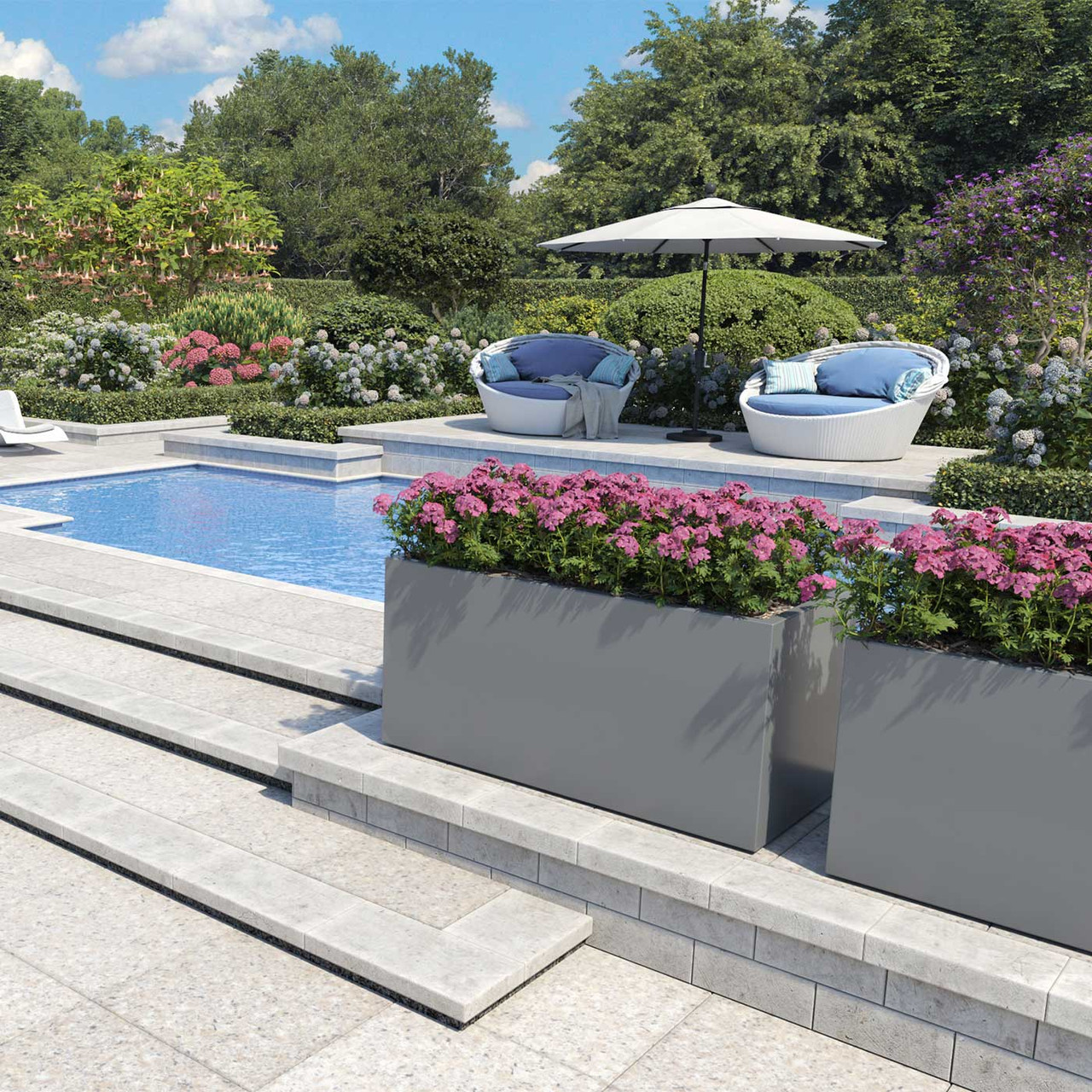
Pool Deck Planters

Pool deck planters need enough scale to work around wide paving, lounge furniture, cabanas, and hospitality or multifamily amenity areas.

Large boxes, low profile planters, privacy planters, and tree-scale planters are common formats.

Planters should define zones without blocking pool access, crowding walkways, or interfering with cleaning.

For pool-specific planning, see the pool deck planters buying guide.

Rooftop Planters

Rooftop planter sizing needs to consider filled weight, wind, drainage, access, privacy, and furniture layout.

Large planters can work on some rooftops, but the full planted system matters.

For commercial rooftops, balconies, terraces, and elevated decks, final placement and load approval should come from the structural engineer of record.

For more rooftop planning, see the rooftop planters buying guide.

Courtyard Planters

Courtyard planters should be sized for the courtyard, surrounding architecture, views from above, seating zones, and planting plan.

Large formats, tree planters, long boundaries, and low profile planters can all work depending on the layout.

For courtyard-specific planning, see the courtyard planters buying guide.

Balcony Planters

Balcony planters need to respect depth constraints.

Slim, modular, low profile, and tall narrow planters often work better than deep round or cube planters in tight balcony layouts.

Filled weight, wind, drainage, door access, and furniture placement should be considered early.

For balcony-specific planning, see the balcony planters buying guide.

Office Divider Planters

Office divider planters need to fit the layout and plant material.

Long boxes, tall narrow planters, low profile planters, and modular runs can divide space without permanent construction.

The planter creates the base. The plant material completes the screen.

For office use cases, see the office planters buying guide.

Storefront Planters

Storefront planters need to be sized for visibility, door access, sidewalk constraints, windows, signage, and street presence.

Tall planters, long rectangular planter boxes, low profile planters, cube planters, and decorative round planters can all work depending on the storefront.

For storefront-specific planning, see the storefront planters buying guide.

Tree Planters

Tree planters need real root volume, stability, drainage planning, and filled-weight planning.

The planter should be selected with the tree, palm, ficus, olive tree, or large shrub in mind.

For tree-scale guidance, see the tree planters buying guide.

Large Planters vs. Too Many Small Pots

Commercial spaces usually look better with fewer properly scaled planters than with many small pots.

Many small pots can look cluttered, temporary, or residential.

Larger planters can create a more intentional commercial result.

They can also reduce layout complexity by defining larger areas with fewer pieces.

This matters for:

  • Broad entries
  • Pool decks
  • Courtyards
  • Patios
  • Rooftops
  • Restaurant fronts
  • Multifamily amenities
  • Shopping centers
  • Hotel and office lobbies

Long runs usually look cleaner with fewer long planter boxes instead of many small containers.

This does not mean bigger is always better.

The planter still needs to fit the access path, installation plan, plant material, drainage approach, and maintenance needs.

For related formats, see large planters, planter boxes, and long planters.

Privacy and Screening Size Considerations

Privacy planter sizing should start with the screen goal.

The planter creates the base. The plant material completes the screen.

Consider:

  • Planter height
  • Plant height
  • Plant density
  • Root volume
  • Width or length of privacy runs
  • Wind exposure
  • Maintenance access
  • Whether the screen is for balconies, patios, pool decks, restaurants, rooftops, or ground-floor units

A tall planter with weak plant material may not create useful privacy.

A shorter planter with the right plant material may create a better screen.

Long planter boxes and privacy planters often work well when the goal is continuous screening.

For more privacy planning, see privacy planters and the privacy planters buying guide.

Filled Weight, Wind, and Elevated Spaces

Empty planter weight is not total weight.

The filled planter system can include:

  • Planter shell
  • Soil
  • Water
  • Drainage material
  • Liner or reservoir system
  • Plant material

This matters for rooftops, balconies, terraces, elevated decks, podium courtyards, upper-floor interiors, and any project with weight or access constraints.

Wind exposure also matters.

Tall planters and tall plant material can catch wind, especially on rooftops, balconies, upper levels, coastal sites, and exposed commercial areas.

For commercial rooftops, balconies, terraces, and elevated decks, final placement and load approval should come from the structural engineer of record.

For more elevated-site planning, see the rooftop planters buying guide and the balcony planters buying guide.

Drainage and Water Management by Size

Larger planters hold more soil and water.

That can be useful for planting, but it also means drainage and water management should be planned early.

Plan for:

  • Runoff planning
  • Indoor floor protection
  • Outdoor drainage
  • Irrigation coordination
  • Maintenance access
  • Rooftop water management
  • Courtyard water management
  • Pool deck and patio cleaning routines

Drainage options can be selected at order and should be coordinated with the site, planting plan, and maintenance approach.

The right drainage approach depends on planter size, plant material, site conditions, maintenance plan, and whether the planter is indoors or outdoors.

For more detail, see the planter drainage buying guide.

Freight, Access, and Installation Constraints

Planter dimensions matter as much as weight.

A planter may be lightweight enough to move but still too long, tall, or wide for the delivery path.

Before choosing final sizes, confirm:

  • Loading docks
  • Elevators
  • Doorways
  • Gates
  • Service corridors
  • Rooftop access
  • Courtyard access
  • Balcony or unit access
  • Staging areas
  • Who receives the freight
  • Who moves and places the planters

Large planters, long planter boxes, tall planters, and oversized round planters should be checked against the real installation path before ordering.

Flat rate shipping & handling. Curbside shipping & handling included on orders over $3,500.

For more planning detail, see the commercial planter delivery guide and the commercial planter cost guide.

Material Choice and Sizing

Material choice affects how practical larger sizes are.

Fiberglass is often the practical default when a commercial project needs scale without concrete-level empty weight.

Fiberglass Planters

Fiberglass planters are useful for sizing-driven commercial projects because they are:

  • Available in large, tall, long, square, round, low, tree, privacy, and decorative formats
  • Lighter than concrete when empty
  • Easier to receive and place than heavier materials
  • Flexible across many finish directions
  • Easier to match across project phases
  • Useful when a project needs large scale without concrete-level empty weight

For large commercial formats, that combination matters.

See fiberglass planters or the fiberglass vs. concrete planters buying guide for more material comparison.

Concrete Planters

Concrete planters can make sense for permanent ground-level installations where weight is acceptable and the design specifically calls for real concrete.

The tradeoffs are freight, receiving, installation, movement, replacement complexity, and less flexibility for rooftops, upper floors, future changes, or difficult access paths.

Metal, Wood, Ceramic, Plastic, and Resin Planters

Other materials can work in certain settings.

Metal may support custom architectural specs. Wood can add warmth. Ceramic can work for smaller decorative interiors. Plastic and resin can work for budget or temporary use.

Each comes with tradeoffs around cost, weight, durability, finish, maintenance, or replacement consistency.

Common Mistakes to Avoid

Choosing Planters From Product Photos Without Considering Space Scale

Product photos can make a planter look larger than it will feel on site.

Always compare the planter dimensions to the building, furniture, walkways, doors, and viewing distance.

Sizing Only for the Plant and Not the Space

The plant matters, but so does the environment around it.

The planter needs to support the plant and match the visual scale of the space.

Using Too Many Small Pots

Many small pots can make commercial spaces look cluttered.

Fewer properly scaled planters often look more intentional and are easier to maintain.

Undersizing Entry Planters

Commercial entries need enough scale.

Small planters can look weak beside tall doors, columns, signs, broad paving, and large facades.

Undersizing Planters in Courtyards and Pool Decks

Courtyards and pool decks often need larger formats because the spaces are broad and frequently viewed from a distance or from above.

Small pots can look scattered or temporary.

Choosing Divider Planters Without Plant Material Planning

The planter alone does not create the divider.

Choose the planter and plant material together so the divider has the right height, density, root volume, and maintenance plan.

Ignoring Walkway and Furniture Clearance

Planters should improve the layout, not crowd it.

Confirm walkways, seating, tables, doors, service paths, cleaning access, and guest or tenant movement before finalizing sizes.

Ignoring Filled Weight on Rooftops and Balconies

The empty planter is only part of the total system.

Soil, water, drainage material, liners, reservoirs, and plant material all add weight.

For commercial rooftops, balconies, terraces, and elevated decks, final placement and load approval should come from the structural engineer of record.

Ignoring Delivery Path Dimensions

The planter has to reach the installation location.

Confirm elevators, doorways, gates, service corridors, rooftop access, courtyard access, and staging areas before ordering.

Forgetting Future Matching and Reorders

Commercial projects often expand.

Planters may need to match future phases, replacement units, additional entries, new patios, or portfolio rollouts.

Choosing repeatable formats and finishes makes that easier.

Recommended PPM Planters by Sizing Need

Brisbane extra large fiberglass planter box for large commercial spaces

Brisbane Extra Large Planter Box

Best for: large patios, courtyards, pool decks, amenity spaces, and broad commercial areas.

Why it fits: the extra-large format gives big commercial spaces the scale they need.

View Brisbane
Wannsee large round fiberglass tree planter for trees and palms

Wannsee Large Round Tree Planter

Best for: trees, palms, entries, courtyards, rooftops, pool decks, and statement planting.

Why it fits: the large round form supports tree-scale visual presence.

View Wannsee
Tolga long rectangular fiberglass planter for commercial dividers and runs

Tolga Long Rectangular Fiberglass Planter

Best for: long runs, dividers, restaurant patios, rooftop edges, walkways, and privacy boundaries.

Why it fits: the long rectangular format creates clean separation with fewer pieces.

View Tolga
Low profile fiberglass planter boxes for sightline-sensitive commercial areas

Low Profile Planter Boxes

Best for: sightline-sensitive areas, patios, pool decks, lounges, walkways, and low dividers.

Why it fits: the low profile format defines space without blocking views.

View Low Profile
Toulan tall tapered square fiberglass planter for entries and vertical accents

Toulan Tall Tapered Square Planter

Best for: entries, door framing, lobby approaches, storefronts, and vertical accents.

Why it fits: the tall tapered form adds height and presence without requiring a wide footprint.

View Toulan
Amesbury tall narrow fiberglass planter box for privacy and tight layouts

Amesbury Tall Narrow Fiberglass Planter Box

Best for: privacy runs, narrow patios, balconies, office dividers, and tight commercial layouts.

Why it fits: the tall narrow profile adds screening height where depth is limited.

View Amesbury
Montroy cube fiberglass planter for entries and structured layouts

Montroy Cube Fiberglass Planter

Best for: entries, modern courtyards, tree planting, structured layouts, and symmetrical designs.

Why it fits: the cube format adds architectural weight and works well in pairs or grids.

View Montroy
Modular 12 inch wide slim fiberglass planter boxes for narrow depth-constrained spaces

Modular 12 Inch Wide Planter Box

Best for: balconies, tight patios, rail-adjacent spaces, phased layouts, and narrow runs.

Why it fits: the slim modular profile works where depth is limited.

View Modular 12

Need Help Choosing Commercial Planter Sizes for an Entry, Patio, Rooftop, Pool Deck, Courtyard, Office, Restaurant, or Landscape Project?

Send us your space type, approximate dimensions, planter locations, plant material, desired privacy level, quantity, finish direction, drainage needs, delivery constraints, and timeline.

We can help recommend planter sizes and formats that fit the space, support the planting plan, and work with the practical requirements of the project.

Start with large planters, commercial planters, outdoor planters, planter boxes, or tree planters.

FAQ

How do I choose the right commercial planter size?

Choose the planter size by looking at the space, plant material, visual scale, filled weight, access path, drainage plan, and maintenance approach.

The planter should be large enough to look intentional in the space and support the plant material without blocking movement or creating installation problems.

What size planter do I need for a commercial entry?

Commercial entry planters should match the scale of the door, facade, signage, and approach.

Tall planters, cube planters, large round planters, and paired planters often work well. The main mistake is choosing planters that look large online but appear too small beside the building.

What size planter works best for trees or palms?

Tree and palm planters need enough volume for the root system, enough visual scale for the plant, and enough stability for the location.

The right size depends on the plant species, root ball, mature size, indoor or outdoor use, exposure, drainage plan, and maintenance approach.

Are larger planters better for commercial spaces?

Larger planters often work better than many small pots in broad commercial spaces, but bigger is not always better.

The planter still needs to fit the space, delivery path, filled weight limits, planting plan, drainage approach, and maintenance needs.

What size planter works best for privacy?

Privacy planter sizing depends on the desired screen height, plant material, density, run length, wind exposure, and maintenance plan.

The planter creates the base. The plant material completes the screen.

What size planter works best for restaurant patios?

Restaurant patios often work well with long rectangular planter boxes, low profile planters, privacy planters, and tall narrow planters.

The best size depends on patio depth, table layout, server paths, guest movement, privacy needs, and cleaning access.

What should I consider when sizing rooftop planters?

Rooftop planter sizing should consider filled weight, wind exposure, drainage, access, furniture layout, privacy, plant material, and installation constraints.

For commercial rooftops, balconies, terraces, and elevated decks, final placement and load approval should come from the structural engineer of record.

Do larger planters need drainage planning?

Yes. Larger planters hold more soil and water, so drainage and water management should be planned before ordering.

Drainage options can be selected at order and should be coordinated with the site, planting plan, and maintenance approach.

What should I check before ordering large commercial planters?

Before ordering, confirm the space dimensions, planter locations, planter sizes, quantities, plant material, drainage approach, filled-weight considerations, access path, freight constraints, installation timing, and whether future reorders need to match.