Loading cart...
Trusted by teams at:





Browse our tree planters below, add likely sizes to your cart, then choose Checkout or ”confirm pricing and lead times” to request a quote for your project.
Where Tree Planters Earn Their Keep
Trees planted in containers carry a location. Hotel entries flanked by palms, corporate lobbies centered on a ficus, rooftop terraces screened by bamboo, restaurant patios defined by olive trees: the planter makes the specimen permanent and the space intentional.
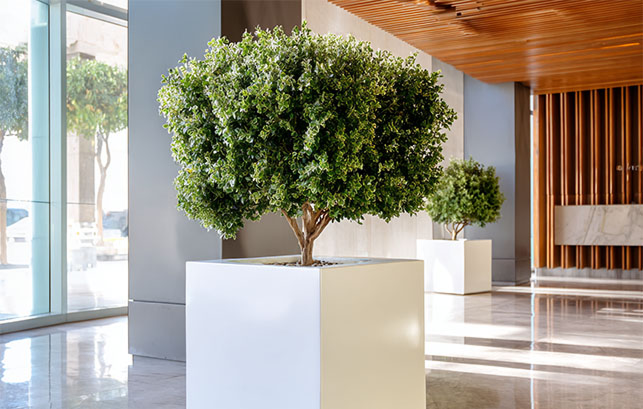
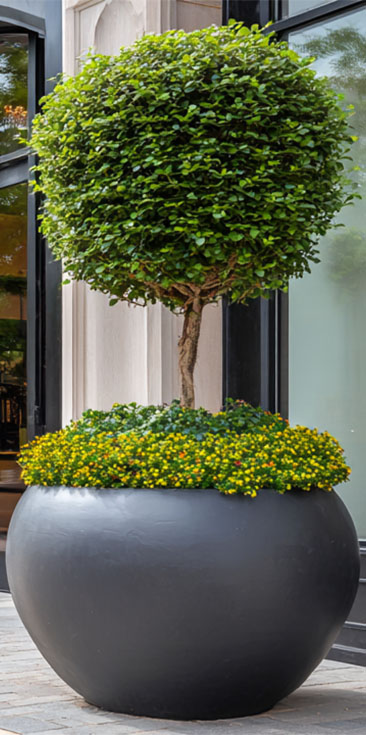
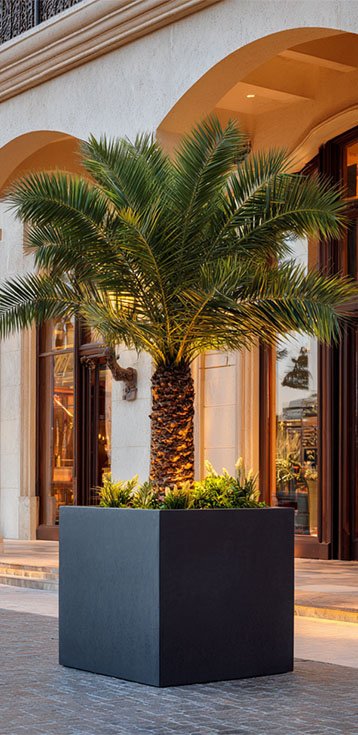
Smart Buying Guide for Tree Planters
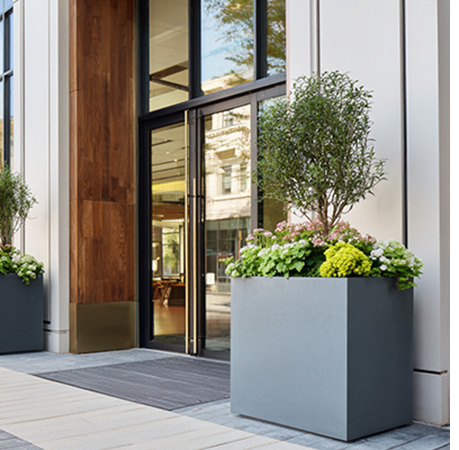
1. Start With Root Volume, Not the Planter Shape
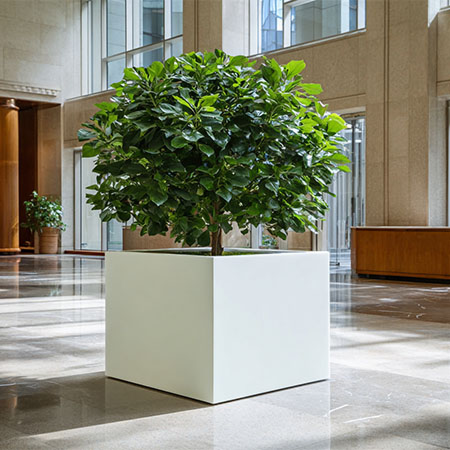
The most common tree planter mistake is choosing a planter that looks proportional to the tree above ground but starves the root system below. For most palms, ficus, olive trees, bamboo, and large ornamental specimens, you need at least 20 gallons of usable soil volume to support healthy establishment in a container. For larger or multi-trunk specimens, 40 to 65 gallons is more appropriate. Measure soil volume by interior dimensions, not overall planter size: a planter with thick walls or a raised base may advertise a 30-inch diameter but deliver significantly less root space than the exterior measurement suggests. When in doubt, go larger on root volume. You can always top-dress and mulch to fill visual space above the soil line.
2. Match Stability to Specimen Height and Exposure
A tall specimen in a shallow, narrow planter is a liability. The rule of thumb for outdoor installations: the planter base width should be at least one-third of the planted specimen's height. A 10-foot palm needs a base of at least 40 inches. For rooftop and terrace installations with wind exposure, factor in the sail area of the canopy and use heavier soil mixes or ballast to lower the center of gravity. Fiberglass planters are significantly lighter than concrete before planting, improving installation logistics, but planted weight is what provides stability. Plan your soil mix and planting density accordingly. For interior installations in lobbies and corridors, stability requirements are lower, but floor protection and ease of repositioning for cleaning resets matter more.
3. Plan Drainage and Maintenance Access Before Install
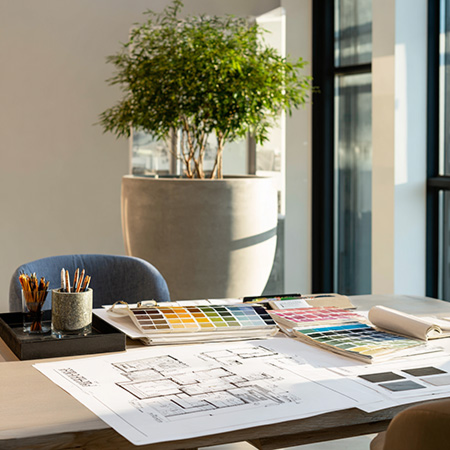
Trees in containers need drainage, full stop. Standing water in a root zone kills trees faster than anything else. Choose planters that ship with drainage holes or can be drilled on site, and confirm the installation surface can handle drainage output. For interior installations on finished flooring, use a reservoir liner system with a subsurface drainage layer so water does not pool at the root zone or flow onto the floor. Plan maintenance access before the planter is installed and planted: once a 1000-pound planted tree is in position, it is not moving easily. The grow pot approach (nursery pot inside the fiberglass planter, with pea gravel infill) simplifies replanting and seasonal swaps without disturbing the planter's position.
Need a fast gut-check on root volume, planter sizing, and lead times? Send us your project specs and we will recommend tree planter options for your project.
Tree Planters Built for Real-World Projects
A tree planter is not just a decorative accent. It is a long-term structural commitment to a specimen and a space. The planter has to handle the weight of mature plantings, the stress of repeated watering and drainage cycles, and the visual expectations of a finished commercial or residential project for years.
Our fiberglass tree planters are reinforced to resist wall flex and bowing when fully planted with heavy, wet soil and mature specimens. Base construction is built wide for stability, not just visual proportion. Exterior-rated finishes maintain color and surface integrity under UV, freeze-thaw cycling, and regular pressure washing for the life of the installation. Every tree planter ships with a three-year commercial warranty. Core SKUs are available in approximately 1 to 2 weeks from US warehouses. Custom dimensions, drainage configurations, and RAL color matching are available for larger projects and multi-site installations.
Trusted Nationwide for Demanding Installations
Professionals specify our fiberglass planters for:
- → Hotels & hospitality
- → Office towers & corporate campuses
- → Retail & restaurant patios
- → Multifamily developments
- → Rooftop lounges & terraces
- → High-end residential projects
Root Volume Engineered for Real Specimens
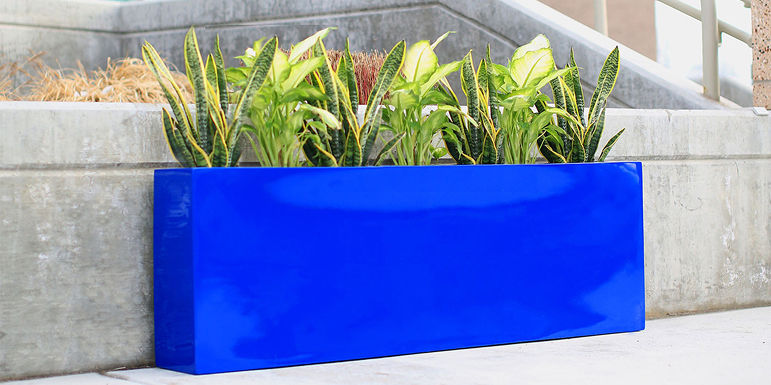
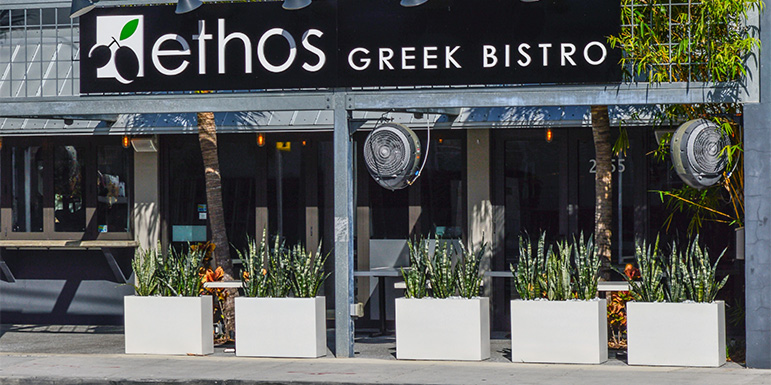
Sized to provide the soil volume palms, ficus, olives, bamboo, and large ornamentals need to establish and grow in a container, not just look proportional from a distance. Interior dimensions, drainage floor placement, and wall thickness are all specified to maximize usable root space within the planter's footprint.
Structural Load Rated for Planted Weight
A large tree planter fully planted with wet soil and a mature specimen can exceed 1000 pounds. Fiberglass wall reinforcement, base construction, and corner radius are all engineered for that load, not just empty display weight. Built to stay rigid and level for years without cracking, settling, or bowing.
Drainage Designed Into the Form
Core SKUs ship with optional pre-drilled drainage holes, and built in fee, positioned for clean outflow without undermining structural integrity. Interior base geometry is designed to prevent pooling at the root zone. Drainage holes can be omitted for interior reservoir liner systems. No field modifications needed for either configuration on most SKUs.
Frequently Asked Questions
Most palms, ficus, olive trees, and bamboo need a minimum of 20 gallons of usable soil volume to establish well in a container. Larger or multi-trunk specimens benefit from 40 to 65 gallons. When selecting a tree planter, check interior dimensions and account for wall thickness and any raised base, which reduce usable root space relative to the exterior planter size.
A general rule: choose a planter at least 2 to 4 inches wider than the tree's grow pot on all sides, and deep enough to cover the root ball with 4 to 6 inches of soil above it. For palms and ficus going into a permanent lobby or entry installation, larger is almost always better. We can advise on specific planter dimensions for your specimen if you share the grow pot size and tree height.
Both approaches work. Planting directly gives the root system maximum space but makes future replanting more involved. Using a grow pot inside the fiberglass planter with pea gravel or decorative stone infill around it makes seasonal swaps and replanting much easier without disturbing the planter's position. For interior installations where the planter is in a fixed location and replanting would require moving heavy furniture, the grow pot approach is strongly recommended.
Base width relative to specimen height is the key factor. The planter base should be at least one-third the height of the planted specimen. On rooftops and exposed terraces, use heavier soil mixes and position planters near walls or screens where possible to reduce wind load on the canopy. Once fully planted and watered, most commercial fiberglass tree planters are stable in standard commercial conditions without additional anchoring.
Yes, and this is one of the most common applications. For interior use, the primary considerations are drainage management (use a reservoir liner system to protect flooring), planter weight when fully planted, and floor protection during any repositioning. Fiberglass is lightweight before planting, which simplifies installation, and non-porous, which means it will not damage flooring or absorb moisture in climate-controlled interiors.
Core tree planter SKUs typically ship in approximately 1 to 2 weeks from US warehouses. For large project quantities, custom dimensions, or custom RAL color finishes, contact us early with your specifications and we will confirm lead times specific to your project scope and installation date.
If You Need Tree Planters, We Are the Team That Makes Your Life Easier
We help designers and property teams choose tree planters sized for the specimen, the installation, and the long-term performance the project demands.
When root volume, stability, finish, and timeline all matter, our tree planters deliver.