Long Planters vs. Individual Containers: When Continuous Runs Actually Make Sense
Posted by Jason Wyrwicz on Feb 3rd 2026
The rule:
Long planters are a commitment. If the layout is fixed, they work. If the space is going to change, they become a problem.
In commercial landscapes and interior environments, the choice between long planters and individual containers rarely begins with plant selection. It starts with how the space is meant to work.
Framing the real decision
Continuous runs are often selected because they create visual order. A clean edge. A clear line. Something that feels intentional on paper and in renderings.
But anyone who has lived with these spaces knows that first impressions fade fast. The real questions show up later. How will the planters be serviced? How will people move around them? How will they age once daily use begins? Those answers determine whether the decision holds up or quietly turns into maintenance fatigue a few seasons in.
What long planters actually solve and what they don’t
When they are planned correctly, long planters do more than decorate. They organize space. In hotel entries, retail corridors, and rooftop terraces, they define boundaries without walls and guide movement without signage. They reduce visual clutter and bring order to busy environments.
What they do not do is simplify a project. Long planters do not automatically save space or budget. Their length introduces coordination around drainage, access, installation, and tolerances. Once they are in place, they are not easily adjusted. A small layout change can ripple across an entire run. Continuity creates clarity, but it also locks in decisions that are expensive to undo.
If you are planning a permanent linear edge, browse the long planter collection. If your project requires a larger visual presence across entrances, plazas, or courtyards, review solutions for large-scale installations.
When individual containers are the better choice
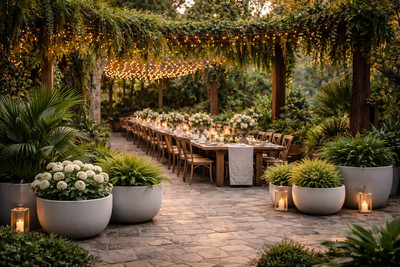
There are plenty of projects where modularity wins. Spaces that evolve with seasons or programming depend on flexibility. Courtyards, lobbies, terraces, and mixed-use areas benefit from planters that can move without dismantling an entire layout.
Maintenance teams feel this immediately. Tight balconies, narrow corridors, and interior installations are easier to manage when containers can be repositioned one at a time. The same applies to properties that refresh plantings for branding or seasonal changes. Flexibility often outperforms continuity once a space has been in use long enough to reveal its habits.
For flexible exterior environments and exposure-driven placements, see planters designed for outdoor environments. For environments where repeat installs and consistency matter, consider commercial-grade planters designed for long-term use.
Maintenance and access: the part most plans ignore
This is where the commitment to continuous runs shows up in day-to-day operations. A single planter run often shares irrigation, drainage, and soil volume across multiple sections. When one area struggles, fixing it without disturbing the rest can take more time than expected. Common issues show up around shared drainage paths, irrigation manifolds buried mid-run, or root balls expanding into areas that were never designed for access.
Individual containers isolate those problems. One unit can be swapped, cleaned, or replanted without affecting the rest. Access matters too, especially indoors where cleaning crews need to reach floors and walls. Long planters perform best when maintenance logistics are designed in from the start, not solved after the fact.
If your plantings include deeper root zones or tree-ready specifications, explore tree-ready planter options. If the install must hold up under constant use, start with commercial-grade planters.
Circulation, safety, and operational access
In commercial environments, circulation is constant. Long planters can quietly guide foot traffic, shape queuing zones, and separate seating from walkways while keeping sightlines open. In hospitality and transit spaces, they add structure without feeling restrictive.
From a facilities perspective, that same continuity can become an obstacle. Service routes, deliveries, and emergency access all require flexibility. Removing one container to create clearance is simple. Doing the same with a fixed run tied into irrigation is not. This is where adaptability earns its keep.
If your goal is to create clean separation lines along edges and paths, start with long planters. If you need a compact footprint with vertical emphasis for entrances or tight paths, see tall planters.
How professionals decide between the two
This is where the decision to commit to fixed runs becomes very real for owners and maintenance teams.
Experienced designers do not start with aesthetics. They start by identifying what is fixed and what is fluid. If a space has permanent edges, built-in seating, or established circulation paths, long planters reinforce those anchors.
In environments that flex, retail forecourts, galleries, and mixed-use terraces, modular containers are more forgiving. The strongest commercial projects are the ones that anticipate how a space will perform years after handover, not just how it photographs on opening day.
When the material decision matters most, review fiberglass planters for strength without the weight of concrete or stone. When the layout decision matters most, use long planters to create continuous runs.
A practical rule of thumb
One simple filter usually clarifies the decision.
- If the layout is permanent and circulation is well defined, continuous runs tend to perform better long-term.
- If the space is expected to evolve seasonally or programmatically, individual containers age more gracefully.
Walking through how the space will actually be used five years from now usually clarifies which option is safer.
Closing
Strong planter strategies are not chosen for appearance alone. They are chosen for how people move, how crews maintain, and how spaces change over time. Long planters and individual containers both have their place, but the projects that hold up best are the ones designed for real use, not ideal conditions.
That is usually the difference between a space that only looks finished on opening day and one that still works after years of use.